- English
- Esperanto
- беларускі
- Hrvatski
- ქართული
- Монгол хэл
- O'zbek
- Հայերեն
- Sundanese
- Español
- Português
- русский
- Français
- 日本語
- Deutsch
- tiếng Việt
- Italiano
- Nederlands
- ภาษาไทย
- Polski
- 한국어
- Svenska
- magyar
- Malay
- বাংলা ভাষার
- Dansk
- Suomi
- हिन्दी
- Pilipino
- Türkçe
- Gaeilge
- العربية
- Indonesia
- Norsk
- تمل
- český
- ελληνικά
- український
- Javanese
- فارسی
- தமிழ்
- తెలుగు
- नेपाली
- Burmese
- български
- ລາວ
- Latine
- Қазақша
- Română
- Srpski језик

How Does Extended Stem Gear Flange Butterfly Valve Solve Operation Barriers for Buried and Insulated Industrial Pipeline Systems?
Abstract
Underground buried pipelines and heavily insulated industrial piping always create inconvenient operation barriers for standard butterfly valves, while conventional short-stem designs require repeated excavation or insulation cutting during routine adjustment and inspection. Extended Stem Gear Flange Butterfly Valve integrates flanged connection structure, worm gear torque reduction drive and customizable lengthened stem assembly, solving the access difficulty of valves installed below ground or wrapped in thick thermal insulation layers. This systematic technical document elaborates core structural composition, standardized material matching rules, multi-scene installation standards, daily inspection and maintenance specifications, as well as engineering selection logic, targeting pipeline designers, site installation technicians and industrial facility operation managers. All analysis focuses on structural stability, sealing durability and operating convenience without involving any profit or cost-related indicators, and compares the practical advantages of this integrated valve type against ordinary wafer butterfly valves and short-stem gear valves in complex piping environments.
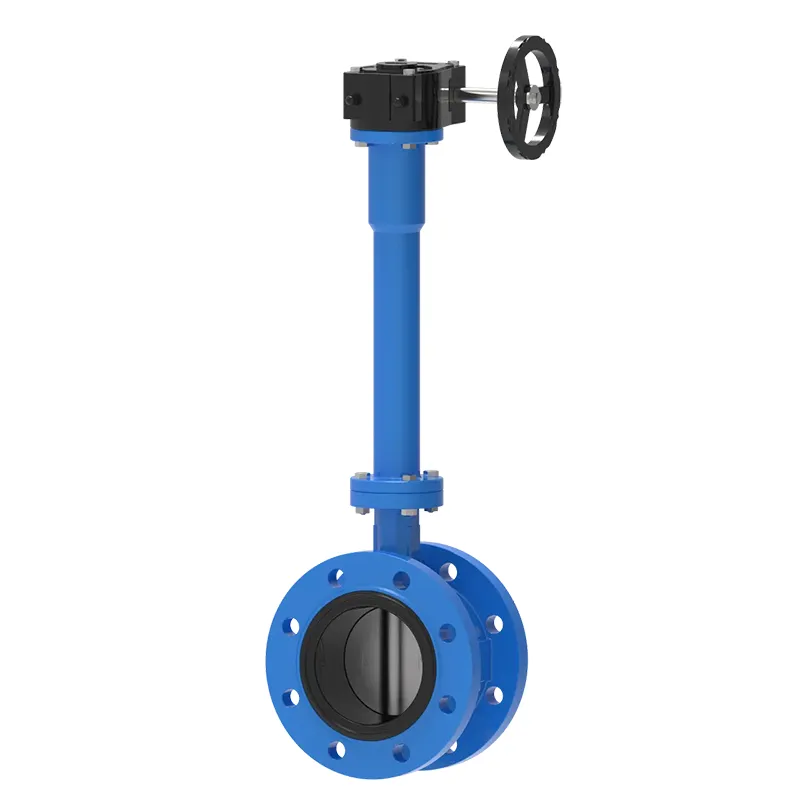
Table of Contents (Click Each Item to Jump to Corresponding Section)
- 1. Complete Structural Composition and Core Working Principle
- 2. Material Matching Standards for Body, Stem and Sealing Components
- 3. Standard Installation Flow for Buried and Insulated Pipeline Layouts
- 4. Main Industrial and Municipal Pipeline Application Scenarios
- 5. Frequently Asked Technical Questions About Stem Length and Sealing Performance
- 6. Regular Inspection and Long-Term Anti-Corrosion Maintenance Guidelines
- 7. Custom Parameter Adjustment and Engineering Technical Support Services
1. Complete Structural Composition and Core Working Principle
1.1 Split Component Layout of Flange, Extended Stem and Gear Drive
Three core functional modules constitute the whole valve body, each undertaking independent pipeline connection, torque transmission and flow regulation tasks respectively. The double-flanged valve body adopts full-face bolted connection form, which forms rigid sealing joints with matching pipeline flanges, avoiding medium leakage risk caused by loose clamping of wafer valves under long-term pressure fluctuation. The extended stem assembly is the most differentiated part compared with common butterfly valves, which extends the gear operating handwheel to accessible ground or equipment platform, separating the operation position from the buried or insulated valve body part.
The worm gear reduction box installed on the top of the lengthened stem converts large torque required for large-diameter disc rotation into light handwheel operation force, which effectively reduces physical labor intensity for operators. Inside the gear box, precision worm and worm wheel meshing structure can lock the disc at any opening angle without auxiliary positioning fixtures, realizing stable fixed flow regulation state for long-time pipeline operation. All transmission parts inside the extended stem adopt integrated spline connection, ensuring synchronous rotation between handwheel gear and internal butterfly disc without transmission slip after thousands of opening and closing cycles.
- Double flange rigid connection improves overall sealing stability under pressure fluctuation
- Customizable lengthened stem transfers operation point out of buried/insulated area
- Worm gear reduction cuts operation torque for large caliber pipeline regulation
- Integrated spline stem structure eliminates transmission slip failure risk
1.2 Medium Interception and Flow Regulation Mechanism
The circular butterfly disc fixed on the bottom end of the extended stem rotates 90 degrees around the vertical central axis to complete full opening, partial throttling and full closing of the pipeline cross-section. When the disc rotates parallel to the medium flow direction, the pipeline forms an unobstructed passage; when rotating perpendicular to the flow direction, the outer edge of the disc closely fits the elastic sealing ring inside the valve body to realize zero leakage interception of liquid, gas and mixed media. The gear box with angle scale can accurately adjust the rotation angle of the disc within 0-90 degrees, realizing continuous linear flow regulation instead of only two-state switch control of simple handle valves.
The extended stem is equipped with multi-layer packing sealing components at the joint of valve body and lengthened sleeve, which prevents pipeline medium from seeping upward along the stem gap to the gear drive area, avoiding gear rust and medium pollution of operation parts. The packing set can be replaced without removing the whole valve from the pipeline during later maintenance, greatly simplifying on-site repair work of buried valves that are difficult to disassemble.
2. Material Matching Standards for Body, Stem and Sealing Components
2.1 Valve Body and Disc Material Classification for Different Media Environments
Material grade selection directly determines the long-term stable operation cycle of the valve under specific medium temperature and corrosion conditions. Ductile iron valve body with epoxy coating is widely used in municipal water supply, fire protection and cooling water pipelines, with good resistance to neutral water medium erosion and low manufacturing processing difficulty. Carbon steel WCB body is suitable for high-temperature steam and oil conveying pipelines, maintaining stable mechanical strength under medium temperature up to 425℃. Stainless steel CF8/CF8M body matches chemical acid-base mixed medium and coastal salt-containing water pipelines, resisting pitting corrosion caused by chloride ions.
The butterfly disc material needs to be consistent with the corrosion resistance grade of the valve body to avoid electrochemical corrosion between different metal contact surfaces. Stainless steel overlay disc is configured for corrosive medium working conditions, while bronze alloy disc is selected for seawater circulating pipelines to prevent marine organism adhesion and electrolytic corrosion damage. All metal casting blanks go through stress relief treatment after forming to eliminate internal deformation stress generated during casting, preventing valve body cracking under alternating cold and hot environment.
2.2 Extended Stem and Gear Box Internal Transmission Material Standards
The lengthened stem bears repeated torsion load in long-term opening and closing cycles, so high-strength stainless steel 410 or alloy steel 4140 materials are adopted, with strict hardness control to avoid galling and fracture during torque transmission. The outer protective sleeve of the extended stem uses seamless steel pipe with anti-rust coating, isolating underground soil moisture and pipeline thermal insulation steam from contacting the torque transmission core shaft, greatly extending the service life of the lengthened stem assembly buried underground for many years.
Worm and worm wheel inside the gear box adopt bronze alloy matching carbon steel worm structure, which forms self-lubricating friction pair during meshing rotation, reducing regular grease maintenance frequency. The gear box shell uses cast aluminum alloy with light weight and strong oxidation resistance, which will not produce heavy rust layer to block handwheel rotation after long-term outdoor exposure or underground vault placement.
| Component Name | Optional Material Grades | Corresponding Applicable Working Conditions |
|---|---|---|
| Valve Body | Ductile Iron / WCB Carbon Steel / CF8 Stainless Steel | Municipal Water / High Temp Steam / Chemical Corrosive Medium |
| Extended Stem Shaft | 410 Stainless Steel / 4140 Alloy Steel | General Buried Pipeline / High Torque Large Caliber Pipeline |
| Sealing Ring | EPDM / NBR / PTFE / Viton | Cold Water / Oil Medium / Strong Acid / High Temp Medium |
| Gear Worm Wheel | Tin Bronze Alloy | All Gear Drive Long Cycle Operation Scenarios |
3. Standard Installation Flow for Buried and Insulated Pipeline Layouts
3.1 Pre-Installation Pipeline and Parameter Confirmation Steps
Before hoisting and connecting the valve body, technicians need to confirm three core customized parameters of the product to match the on-site pipeline layout: actual buried depth or insulation thickness to determine the required extended stem length, pipeline nominal pressure to select matching flange pressure grade, and medium type to check whether the disc and sealing material grade meets anti-corrosion requirements. Mismatched stem length will cause the gear handwheel to sink into the buried vault or be covered by pipeline insulation, losing operability; mismatched flange pressure grade will lead to flange gasket leakage under pipeline design pressure.
Clean the flange sealing surface of the front and rear pipelines thoroughly, remove welding slag, rust spots and hard particle attachments, to avoid scratch damage to the elastic sealing gasket during bolt tightening. Place the matched non-metal flat gasket between the two groups of flanges, and align all flange bolt holes horizontally to prevent eccentric extrusion of the gasket caused by offset installation of the valve body, which will form local medium leakage passage after long-term operation.
3.2 Buried Pipeline Special Fixed and Stem Protection Operation
After the valve body flange is fully bolted and fastened by cross symmetrical tightening sequence, fill graded sand around the valve body for layered compaction, avoiding large hard stones directly extruding the valve shell to produce local deformation. The outer protective sleeve of the extended stem needs to be wrapped with waterproof anti-corrosion coiled material from the valve body to the ground operation platform, blocking underground groundwater and corrosive soil from contacting the stem metal parts. A hollow protective manhole cover is reserved at the ground end of the stem, which can be opened directly to operate the handwheel without large-area soil excavation during later inspection and adjustment.
For thickly insulated indoor pipeline installation, reserve a vertical channel matching the extended stem outer diameter at the pipeline insulation wrapping position, do not wrap thermal insulation cotton around the gear box and stem exposed section, to prevent heat accumulation from accelerating gear lubricating grease deterioration and aging of top packing sealing parts. After installation, conduct full stroke opening and closing test of the handwheel to verify that the disc rotates without jamming and the angle scale indication is consistent with the actual flow interception state.
- Cross symmetrical flange bolt tightening to prevent gasket eccentric extrusion leakage
- Waterproof protective wrapping for extended stem buried section against soil corrosion
- Reserve independent vertical channel for stem to avoid insulation wrapping gearbox
- Full stroke opening-closing test to eliminate disc jamming hidden danger after installation
4. Main Industrial and Municipal Pipeline Application Scenarios
4.1 Municipal Underground Water Supply and Fire Protection Pipe Networks
Urban municipal water distribution pipelines and buried fire fighting ring pipes are the most widely applicable fields for this lengthened stem flange valve. Most main pipeline branches are laid below road surface or green belt soil, and ordinary short-stem valves need large-scale road excavation every time flow adjustment or pipeline cut-off maintenance is carried out, which brings great interference to urban traffic and daily resident life. Extended Stem Gear Flange Butterfly Valve extends the operating gear handwheel to ground inspection well positions, and all opening, closing and flow throttling operations can be completed only by opening the well cover, without road surface excavation and pipeline soil backfilling construction work.
Municipal fire protection pipelines require stable sealing performance under instantaneous pressure surge when fire pumps start. The double flange rigid connection and multi-layer elastic sealing ring structure can bear instantaneous pressure impact without medium seepage. The worm gear self-locking structure can keep the valve fully open for a long time in daily standby state, and will not automatically close due to pipeline water flow impact vibration, ensuring unobstructed fire fighting water passage in emergency response periods.
4.2 Factory Insulated Medium Conveying Pipelines
Chemical plant high-temperature steam, hot oil and refrigerated brine pipelines all need thick thermal insulation layers to reduce medium temperature loss and avoid surface scald accidents for on-site operators. If standard short-stem butterfly valves are adopted, the insulation layer around the valve must be cut open every time the flow is adjusted, and new thermal insulation cotton needs to be re-wrapped after operation, resulting in repeated waste of thermal insulation materials and frequent heat loss of the pipeline. The lengthened stem structure separates the operation gear box from the insulation wrapping area, the pipeline insulation can be continuously wrapped as a whole without local cutting, maintaining complete thermal insulation effect of the whole pipeline for a long time.
Large-scale food processing and pharmaceutical factory clean water circulation pipelines also select this flange butterfly valve with extended stem gear drive. The full stainless steel contact medium parts match sanitary production standards, and the gear operation mode realizes precise small-range flow regulation, which can stably control the medium flow required by production equipment without instantaneous large flow fluctuation affecting product processing stability.
4.3 Park Underground Rainwater and Sewage Discharge Pipelines
Campus, industrial park and residential community buried rainwater and sewage branch pipes are buried under green land and sidewalks, with scattered inspection wells reserved at intervals. The lengthened stem design of the valve perfectly matches the vertical depth of these inspection wells, maintenance personnel can directly reach the gear handwheel at the well mouth without going down the deep well for operation. The epoxy anti-corrosion coating of ductile iron valve body resists long-term erosion of sewage containing organic impurities, and the replaceable outer sealing ring can be maintained on site without integral valve disassembly from the pipeline.
- Municipal buried water pipes eliminate road excavation work during valve adjustment
- Insulated factory pipelines avoid repeated cutting and re-wrapping of thermal cotton
- Fire pipeline gear self-locking prevents accidental closing under water flow vibration
- Sewage pipe anti-corrosion coating adapts long-term organic medium erosion
5. Frequently Asked Technical Questions About Stem Length and Sealing Performance
1. Can the extended stem length be modified after the valve leaves the factory?
The lengthened stem assembly adopts integrated seamless sleeve and core shaft welding forming process, and fixed torque transmission spline structure is set inside the whole stem. Secondary cutting and welding after leaving the factory will destroy the coaxiality of the torque transmission shaft, leading to disc jamming and gear operation failure during rotation. All required stem lengths need to be confirmed and customized before production according to on-site buried depth or insulation thickness data.
2. What leakage hidden dangers will occur if the flange bolt tightening sequence is disordered?
Sequential single-side tightening will cause unilateral compression of the flange sealing gasket, forming uneven extrusion gap around the gasket. Under pipeline pressure fluctuation, medium will seep out from the loose gap side, and long-term eccentric stress will also deform the valve body flange edge, permanently damaging the flatness of the sealing surface. Cross symmetrical multi-point gradual tightening is the only standard operation flow.
3. How to judge whether the packing sealing at the top of the extended stem needs to be replaced?
If medium liquid or gas continuously seeps out from the gap between the stem outer sleeve and gear box base during pipeline normal pressure operation, it means the internal packing ring has aged and lost elasticity. The packing can be supplemented and replaced without removing the whole valve body from the pipeline by only disassembling the gear box upper cover.
4. Is the gear box able to work stably in long-term underground damp inspection wells?
The gear box shell adopts fully sealed cast aluminum structure with built-in permanent lubricating grease cavity, and the joint surface is equipped with waterproof rubber gaskets to block underground damp air from entering the internal meshing parts. Regular annual inspection of grease filling quantity can maintain stable gear operation for more than ten years without rust jamming.
6. Regular Inspection and Long-Term Anti-Corrosion Maintenance Guidelines
Buried and insulated installation environments accelerate the aging of valve external components, so standardized periodic inspection and maintenance cycles must be formulated according to different working conditions to avoid sudden sealing failure or transmission jamming during pipeline operation. Extended Stem Gear Flange Butterfly Valve has split replaceable wearing parts design, most maintenance operations can be completed on site without pipeline shutdown and integral valve disassembly, greatly reducing pipeline system downtime duration caused by maintenance work.
6.1 Monthly Routine Inspection Items for Gear Operation Parts
Open the ground manhole cover or pipeline insulation reserved operation channel, rotate the handwheel back and forth for full stroke opening and closing, observe whether the rotation process has abnormal blocking and abnormal friction noise. Check the angle scale pointer of the gear box to confirm that the indicated opening degree is consistent with the actual flow interception state of the disc. Wipe off surface dust and damp mud stains on the gear box shell, check whether there is medium seepage trace at the stem packing upper end, and record the seepage amount for subsequent packing replacement arrangement.
For gear boxes installed in underground damp inspection wells, wipe the outer shell with dry rag every month to remove condensed water droplets attached to the surface, preventing long-term damp corrosion of the aluminum alloy shell surface from producing perforation damage to the internal sealing grease cavity. If the handwheel rotation resistance obviously increases compared with the previous inspection record, supplementary lubricating grease needs to be injected into the gear box through the reserved grease injection nozzle.
6.2 Annual Deep Anti-Corrosion and Sealing Replacement Maintenance
Carry out full anti-corrosion inspection of the extended stem outer protective sleeve every year, check whether the outer waterproof anti-rust coiled material has cracking, falling off and soil water seepage into the sleeve gap. Damaged anti-corrosion wrapping parts need to be re-wound with new waterproof coiled material, and the joint gap is sealed with anti-rust sealing glue to block underground corrosive medium contact with the metal stem shaft.
Take out the aging elastic sealing ring inside the valve body through flange disassembly during annual pipeline shutdown maintenance, replace it with a new sealing ring matching the medium temperature and corrosion grade. Check the surface scratch and corrosion degree of the butterfly disc, polish and repair minor rust spots on the disc surface, and carry out supplementary anti-corrosion coating treatment before reinstallation into the valve body. All replaced old sealing accessories are classified and recycled in accordance with industrial waste management standards without random discarding.
- Monthly full-stroke handwheel rotation test to screen transmission jamming hidden danger
- Timely supplementary gear lubricating grease when rotation torque increases obviously
- Annual re-wrapping of damaged stem outer waterproof anti-corrosion layer
- Replace aging inner sealing ring during pipeline regular shutdown maintenance
Standard fixed stem length, flange pressure grade and sealing material configuration can meet most conventional municipal and factory pipeline projects, but special buried depth, ultra-thick pipeline insulation, high corrosive medium and super large caliber engineering projects require targeted customized parameter adjustment of valve components. Off-the-shelf standardized products cannot adapt to special pipeline layout space constraints and medium corrosion working conditions, so professional customized production can match the unique technical parameters of each independent engineering project one by one.
Waits Valve Co., Ltd. has complete casting, precision machining and assembly production lines dedicated to the production of gear flange butterfly valves with extended stems, and accumulates abundant engineering matching experience in municipal water supply, chemical industry, food processing and park buried pipeline projects. All product production processes comply with API609, ANSI B16.5 and GB/T13927 international and domestic pressure vessel valve testing standards, ensuring consistent sealing performance and transmission stability of customized batch products.
Customizable Product Parameter Range
Adjustable customized items include extended stem overall length, flange pressure class PN10/PN16/150LB, valve body and disc material grade switching, sealing ring medium adaptation material replacement, gear box installation height and handwheel size matching. According to the buried depth, medium temperature and medium corrosivity provided by engineering designers, the technical team optimizes the component material matching scheme to avoid premature aging and failure of valves after project operation.
Supplied Engineering Technical Documents
Complete dimension drawing files, material chemical composition inspection reports, pressure sealing test records and installation operation guidance manuals can be provided for each customized order, which can be used for engineering drawing review, construction acceptance and daily operation management reference. Physical test pieces are not provided for all project consultation demands.
Before submitting customized production requirements, sort out complete on-site pipeline technical parameters including pipeline nominal diameter, buried depth or insulation total thickness, medium type and operating temperature, pipeline design pressure and installation space reserved size. Complete parameter information can shorten the scheme confirmation cycle and avoid dimensional modification delay caused by incomplete data after product production is completed.
Submit your pipeline buried depth, medium parameters and engineering layout restrictions, contact us to obtain targeted customized valve design schemes and complete supporting technical certification documents.
Submit Engineering Custom InquiryPrevious:No News